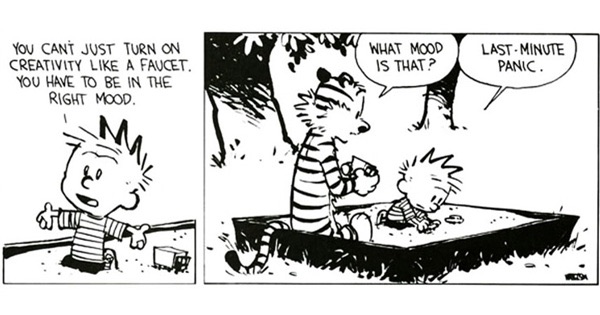
In a fictional story about the CEO & founder of a small marketing consulting firm – Jeremiah Marketing – the protagonist’s teams asks him a few questions.
Why are you like this?
30 seconds ago you where exasperated. And now you are lit up about a new idea
You go from frustrated to inspired in seconds
Jeremiah had a successful career as a young marketing executive in multiple large firms. But hated the journey of trying to fit into complex matrix structures and energy drain of playing leadership roles. He felt every promotion took him away from his core joy and genius of solving client problems in unique ways. So he finally started a small consulting company of his own. Built a great team. A strong core team. That worked and played together.
Yet off late he was back to his grumpy self again. Behaving and feeling the same way as he did in all the companies he hated and quit to start this one.
What an ironical situation to be in.
I wish I understood why
Half the time I am psyched about work
Half the time I am frustrated
Half the time I am confused by it all
Replied Jeremiah. With 3 halves of a whole 🙂
The conversation with his team then expands. Opening both a can of worms and a box of chocolates. And they start to share more and ask more provocative questions. And a solution, not just for Jeremiah, but for their entire organisation as well as a framework for any emerges.
This fable is from the latest book by Patrick Lencioni (the author of iconic The Five Dysfunctions of a Team) called The 6 Types of Working Genius.
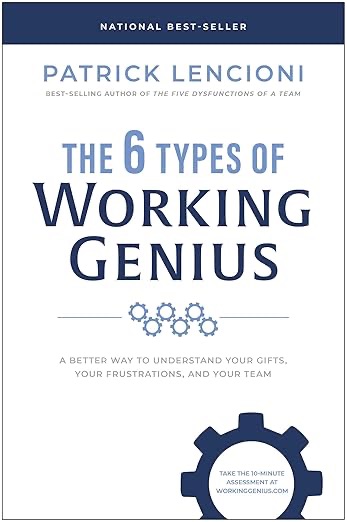
The core premise of the book is that there are 6 types of natural and special super powers – genius abilities – we can have. Most people have 1-2. Rest they struggle and get frustrated if they need to do them all the time. Any project needs all 6 genius abilities. Key to success and joy is to align people to work and roles in sync with their genius, and complement each other with other geniuses. Work can be anything ranging from delivering a project, building an organisation, overcoming a challenge or even volunteering to do things together for your church.
These 6 genius abilities (explained and elaborated with my understanding and words) are
Wonder
Ability to ponder possibilities and see the potential in a given situation. Manifests as asking first principles based and why questions. And ability to ignore the baggage of the past and reimagine a new future.
Invention
Ability to create new and novel solutions from scratch. Able to build rapid prototypes and get things of the ground.
Discernment
The natural gift of evaluating options intuitively. Across topics and situations. With or without having in-depth knowledge or putting in the ground work. Smell test and tasting abilities to judge on various dimensions including success, execution path, value, messaging, positioning or failure points.
Galvanising
Abilities to rally every one to a cause and take action. To be able to evangelise. Excite. And most importantly push and exhort others to get going. To push beyond capabilities, constraints and boundaries.
Enablement
Being a coach. Ability to support and help. To provide necessary resources and help needed for execution. And often just being there, being a patient listener.
Tenacity
Staying thru till the end. Ability to complete. To tie the lose ends. Cross all the ts and dot all the is, that got left out. Celebrating the last 20% and crossing the finish line. Ignoring the temptation of the next cool project or idea – till this is complete.

The framework can apply to both personal and professional situations. I loved the simplicity and framing.
The book is decent read. There could have been more depth and nuance. But the author – who also runs a consulting and coaching business – wants us to buy the assessment separately and bring them in as a consultant or get certified. So made this more of teaser than the whole enchilada. The fable is a light read and better way than ploughing thru the framework – but conversations are cheeky and corny at times.
Off late I have been feeling and behaving a lot like Jeremiah. And have been asked the same question by my team, peers and bosses. Why are you like this? So this resonated with many questions I have been pondering on.
At the end of the book I was asking myself a few questions …
What are the natural genius and frustrations of my team members? Are their roles playing up their genius, and covering for their frustrations?
Why do organizations insist on private individual performance feedback and appraisals at the end of a year? Why can’t there be group performance and annual feedback mechanisms – if we all truly believe winning is a team sport?
What is my natural genius? What are my frustrations? And how can I get others to understand and work with my natural abilities. While supporting me and not judging me for my limitations on the rest?
How does one develop a two state mind or a stateless mind where you are neither enjoying / exhilarated applying your natural abilities not angry or frustrated when asked to work on those that are not. As no one can afford to only do things you enjoy, in real life
How does this change the way we parent, or not at all to stay out of the way with our children? Can we help them see their natural genius and play to them? While working on their frustrations in parallel.
Can this be a way to understand the frustrations of my wife, and partner over 22 years? Who keeps saying she would love have a husband who is not just a creative problem solver or a crisis manager. But also someone who shows up in normal day 2 day settings 🙂
Every genius is misunderstood. What are the mis-understandings that come in the way of being accepted for what you do well? For example, Wonder can be easily mis understood as not being grounded in reality and may be even flippant. A topic for another post may be 🙂
 Sridhar Turaga's blog